


Special Events
Exploring the gravitational-wave sky
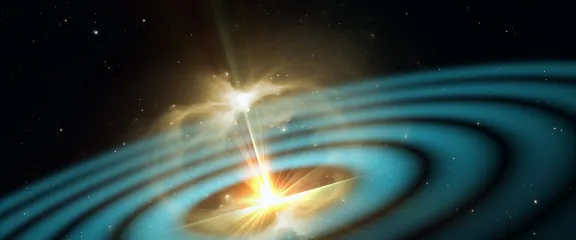
Join us in the Planetarium at Glasgow Science Centre for a family lecture to celebrate the 10th birthday of gravitational wave astronomy; a new branch of astronomy that uses tiny ripples in the very fabric of space to study our cosmos like never before.
Although they were first predicted by Albert Einstein over 100 years ago, decades of research were needed to develop the technology to detect gravitational waves, and the University of Glasgow has long been at the forefront of this research. From the first detection of colliding black holes in September 2015, to the hundreds of detections made since then, in this family lecture, you'll hear about how this new way to see the Universe is revolutionising our understanding of how stars live and die, the nature of gravity, and the evolution of the Universe itself.
This lecture will be delivered by members of the Institute for Gravitational Research at the University of Glasgow, one of the oldest and largest gravitational-wave research groups in the world. The team has made many pioneering discoveries, and its expertise spans everything from groundbreaking detector technologies, exacting data analysis, and astrophysics.
The lecture lasts for 45 minutes, including Q&A, is suitable for ages 8+, and no background knowledge is required.
Please note this does not include entry to the Science Mall at Glasgow Science Centre.
Day Entry Tickets can be purchased here and on the 9th May include the opportunity to take part in some hands-on activities exploring the science behind gravitational waves, listen to the sounds of colliding black holes, and experiment with the technology behind gravitational-wave detectors. Ask the friendly researchers your space-related questions, and learn about the diverse, cutting-edge research being done right here in Glasgow.
Your donations make a real difference!
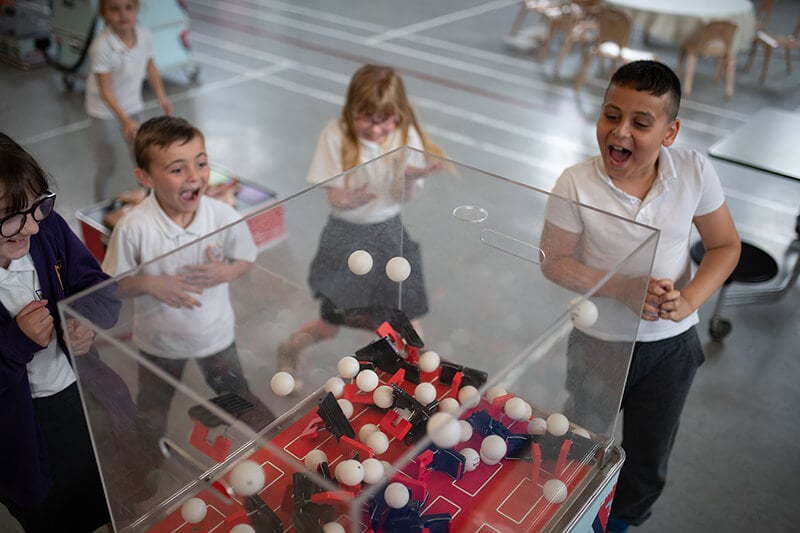
As a registered Scottish charity, our mission is to engage and inspire people of all ages and backgrounds to discover and enjoy science. Your generosity will allow us to continue to provide fun and informative outreach programmes for young people and to work with communities from the local area and across Scotland, making a real difference to people's lives. We appreciate your support.
Science Passport
Get unlimited access to the Science Mall for a year when you become a member of our Science Passport scheme.
Price
£44.25 per adult | £39.45 per concession | £34.50 per child | Under 3s go free!
Buying a Science Passport
The best way to purchase is online as you will be able to manage your Science Passport and renew through your online account in future and we will keep you up to date when your year is nearly up.